
In this radical cross-disciplinary treatise, Dr. Olivier Champignons posits that microscopic pathogens do not merely infect human hosts—they communicate through structured syntactic principles that mirror human language grammar. By analyzing viral mutations alongside the evolution of regional dialects, the author demonstrates how cellular vectors rely on phoneme-like signaling mechanisms to bypass immune systems. Champignons meticulously bridges epidemiology and formal linguistics, mapping out a full syntax for viral transmission across isolated human populations. The text tracks historical outbreaks, revealing how major epidemics coincided with shift points in regional phonetic development. Ultimately, the work suggests that curing future viral threats requires decoding their innate biological grammar rather than relying solely on traditional pharmaceutical suppression.
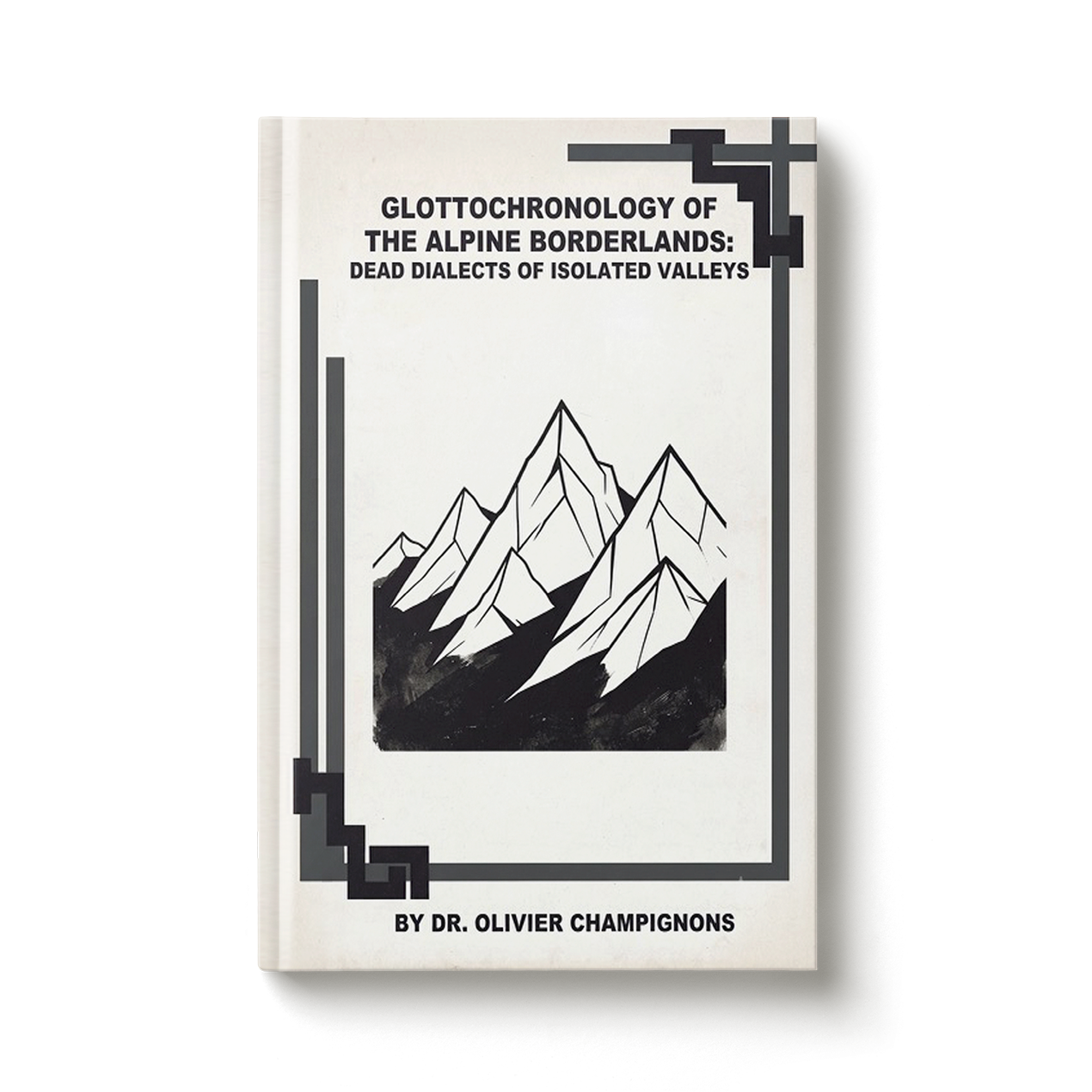
Glottochronology of the Alpine Borderlands: Dead Dialects of Isolated Valleys
“Champignons has achieved something bafflingly brilliant or brilliantly unhinged: he treats the common flu like a lost Romance language. I haven’t slept in three days trying to prove his third chapter wrong, but the mathematics of his viral syntax hold up.” — Dr. Aris Thorne, Journal of Unorthodox Epidemiology
“A towering, terrifying fusion of socio-linguistics and cellular biology that leaves the reader questioning every cough heard in a crowded train station.” — Substack Review: ‘The Obscure Academic’
“Honestly bought this thinking it was a sci-fi novel, but ended up reading 400 pages on cellular syntax. 10/10 would accidentally become obsessed again.” — @linguistics_guy99 on Reddit

“The pathogen does not whisper; it syntax-checks its entry. When the spike protein meets the host membrane, it executes a sequence indistinguishable from a dialectical shift in late 14th-century Anglo-Norman. To treat the resulting inflammation without addressing the underlying semantic dialogue between virus and cell is akin to painting over a glowing signal fire. We must learn to read the pathogen before we can hope to silence it.”